
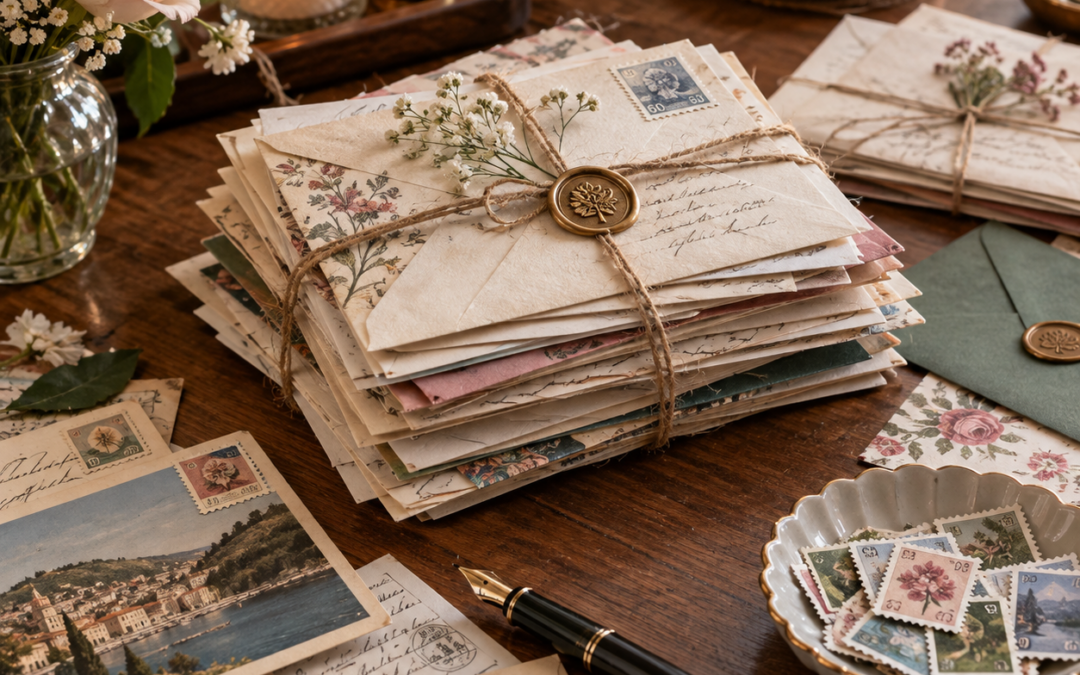
My mother recently died, and in the days since, my sister and I have found ourselves looking at the cards and letters she kept in her room. She had placed them where she could see them every day. Some were from friends, some were from family, and some were from her granddaughters. She was always especially proud when they wrote to her in Spanish. They were not necessarily long letters or elaborate messages. Many were simply cards, short notes, or a few handwritten sentences. But she kept them. She displayed them. She looked at them. And now my sister and I are standing in that same room, wondering what to do with them.
That question has made me think even more deeply about the importance of a letter. My mother had beautiful handwriting. Truly beautiful handwriting. It was precise, graceful, and immediately recognizable as hers. I can still remember one summer when she decided that my sister and I needed to work on our handwriting. We practiced and practiced. At the time, I am sure we wondered why this was so important to her. Now I understand it differently. Handwriting was part of how she communicated. It was personal. It was something you gave another person.
My mother continued sending cards and short notes throughout her life. She was one of those people who understood that you did not need a great occasion or several pages of news to put something in the mail. Sometimes a few sentences were enough. She also loved receiving mail, and as the years passed and her days became quieter, those cards seemed to mean even more. A piece of mail arriving with her name handwritten on the front told her that somewhere, someone had stopped what they were doing and thought about her.
A letter is a remarkably small object. A sheet of paper, an envelope, a stamp, maybe five or ten minutes of someone’s day. Yet that little thing can make a tremendous difference in another person’s life. A card can arrive on a lonely afternoon. A note can reach someone who has begun to wonder whether people still think about them. A letter can make an older person feel connected to family members whose lives may have become very busy. It can say, “I remember you,” without ever using those exact words.
That is what I now see when I look at the cards in my mother’s room. I see evidence that people remembered her. And more importantly, she saw it too. She put those cards where she could see them because they mattered to her. The person who mailed one of those cards may have spent only a few minutes writing it. They probably did not imagine it would later be propped up in her room and read again and again. That is one of the remarkable things about sending mail. We rarely know what happens to our words after they leave us.
My sister and I have been asking ourselves what to do with those letters now. Do we keep them all? Do we divide them between us? Do we save only certain ones? Part of me finds it difficult to simply put them away because my mother deliberately kept them visible. They became part of the landscape of her room and, in a small way, part of the rhythm of her days. I think some will be saved. Perhaps we will place them in a box or album rather than trying to decide immediately which ones are “important.”
Because right now, their importance is not really about what each card says. It is about what they collectively represent. They are a record of people reaching toward her. Friends remembering her. Family thinking about her. Granddaughters writing to their grandmother in Spanish and making her enormously proud. Tiny acts of connection accumulated over time.
When we talk about letter writing, it is easy to focus on the beautiful parts of the hobby: fountain pens, stationery, stamps, wax seals, lovely envelopes. I enjoy all of those things, and they make correspondence pleasurable. But they are not why letters matter. The real value of a letter is the person on the other end.
Sometimes we hesitate to write because we think we do not have enough to say. Write anyway. Sometimes we think a birthday card is too ordinary. Send it anyway. Sometimes we think a short note hardly counts as correspondence. It counts. The card you almost did not send might remain on someone’s nightstand for months. The note you wrote quickly at the kitchen table may become something someone reads several times.
And someday, after that person is gone, their family may stand in a room looking at those letters and suddenly understand just how much they meant.
I know that now.
My mother taught my sister and me to pay attention to our handwriting all those summers ago. I doubt any of us imagined that decades later I would spend so much of my life encouraging other people to put pen to paper. But perhaps those lessons stayed with me in ways I did not recognize. Today, when I encourage someone to write a letter, it means something a little different.
Write to your mother. Write to your grandmother. Write to the friend you have been thinking about. Write to the person who lives alone. Write to the person you assume already knows you care. Send a postcard to a child. Send the birthday card. Send the thank-you note. And do not worry if you only have a few sentences to say.
Because sometimes a letter is not little at all.
Sometimes it becomes something a person places beside their bed so they can see it every day. And sometimes, after they are gone, it becomes proof that they were remembered and loved.
That is why we write.
Arizona Correspondence Society
Letters. Friendship. Connection.
Recent Comments